
This vineyard is planted into the Bokkeveld shale soils of the Witzenberg mountain range, atop the Ceres Plateau. Situated in one of South Africa most elevated growing regions, this vineyard has an altitude of over 1000m.
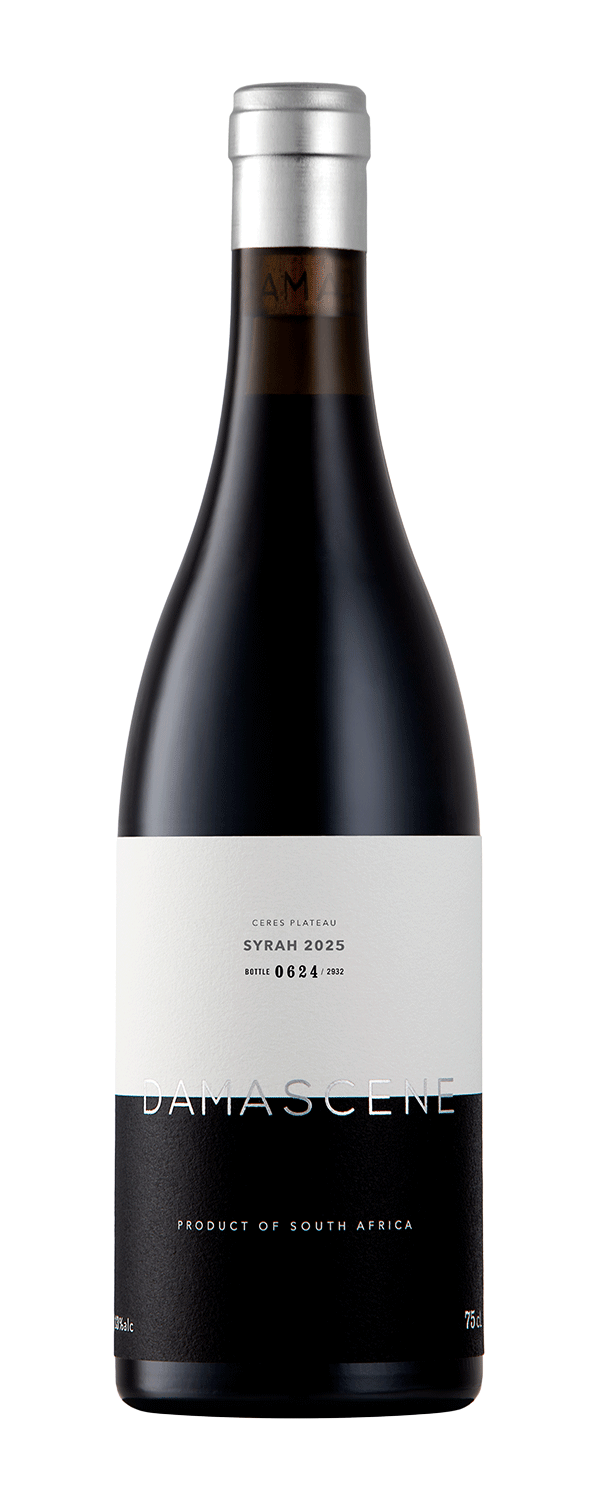
Wine of Origin Ceres Plateau
| Winemaker: | Jean Smit |
| Cultivar: | 100% Syrah |
| Origin: | Ceres Plateau |
Tasting notes:
The highest-grown wine in the Damascene range, the 2025 Ceres Plateau Syrah is a study in altitude: pure, focused, and cut with a floral spice all its own.
The nose is open and welcoming — juicy blackberry with a candied edge, purple flowers, and a savoury, subtle note of baked cherry skin behind the fruit. The palate is gentle in mouthfeel but never in tension, holding black cherry and candied pomegranate against the lift of Madagascan pink peppercorn. Fine grape-skin tannins gather as the fruit recedes, and the finish is long and cool. Time in the glass sees those spice notes develop further rather than fade.
Notes on the 2025 Vintage:
The 2025 season across the Cape was late, cool and clean, and the Ceres Plateau turns every one of those conditions up a notch. Winter was wet and late to arrive, delaying the onset of budburst in spring. Summer brought with it a single sharp heat spike over Christmas, but turned decisively cooler after that. The harvest itself was dry, with no meaningful rainfall and no disease pressure of consequence.
Fruit was hand-picked between 11 and 18 March 2025 — a week later than in 2024 and, as ever, Ceres Plateau was the final Syrah block we brought in.
Vineyards:
This vineyard is planted into the Bokkeveld shale soils of the Witzenberg mountain range, atop the Ceres Plateau. Situated in one of South Africa’s most elevated growing regions, the site sits at over 1000m above sea level and presents all the textbook extremes of high-altitude viticulture. In winter, the vineyard is often blanketed in snow, while a dramatic diurnal shift slows ripening. It is invariably the final Syrah block we harvest each year.
Winemaking:
The fruit was harvested by hand between 11 and 18 March 2025. Syrah from the Ceres Plateau carries immense natural intensity, so the winemaking calls for a gentler hand. Higher natural tannins meant only 60% of the fruit was fermented as whole clusters, with the balance destemmed and fermented as whole berries. Fermentation took place in tulip-shaped concrete fermenters using a submerged-cap technique, helping to soften the wine’s structure while preserving its clarity. Both primary and malolactic fermentations occurred spontaneously. The wine was then matured in 2000L Austrian foudre for ten months, and bottled without fining to preserve a more complex and authentic expression of Syrah.
Maturation:
This wine will continue to mature and improve for at least a decade.
Technical:
Total production: 2932 x 750ml and 100 x 1500ml
Bottling date: 15 January 2026
Alc: 13.01 % Vol
pH: 3.62
TA: 5.3 g/L
RS: 1.7 g/L