
Syrah grapes were sourced from three distinct vineyards; a cloud-covered Polkadraai hill, a granitic outcrop in Bottelary, and a sheltered nook in Devon Valley.
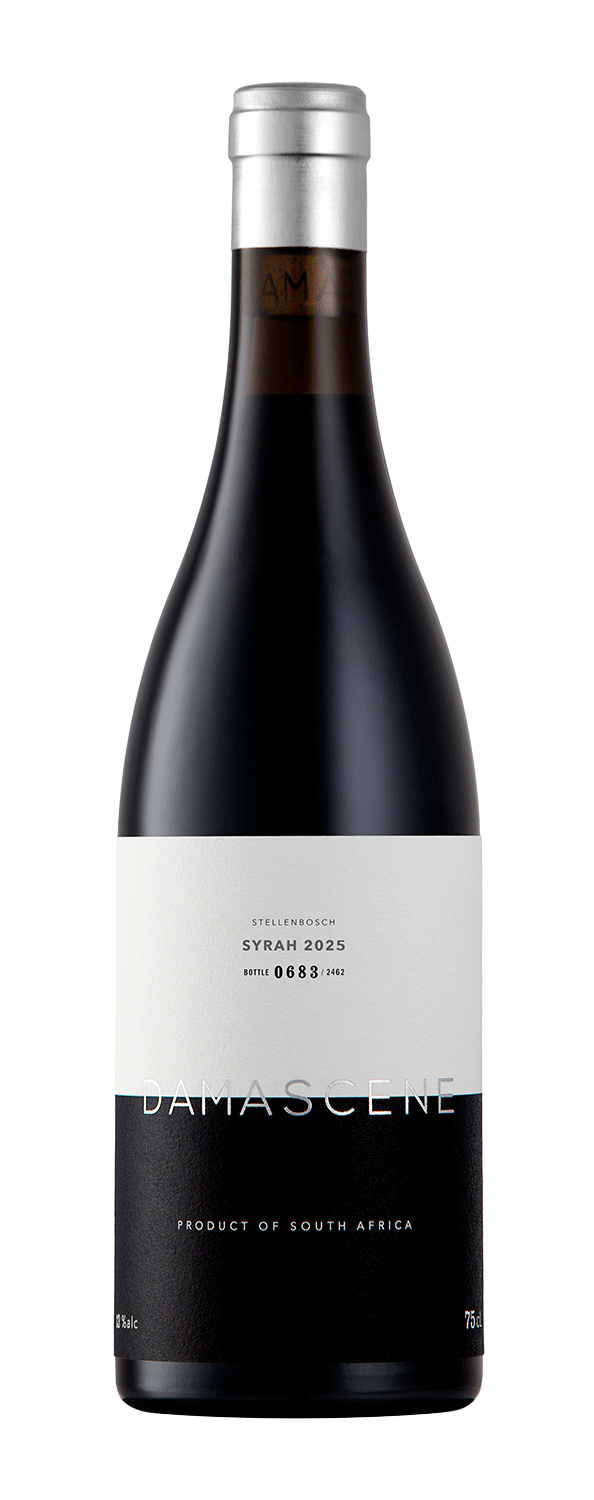
Wine of Origin Stellenbosch
| Winemaker: | Jean Smit |
| Cultivar: | 100% Syrah |
| Origin: | Stellenbosch |
Tasting notes:
The most structured of our three Damascene Syrahs, the 2025 Stellenbosch is built on roasted berry fruit, pepper spice, and a savoury olive depth.
The nose is savoury before it is fruited: olive tapenade and a green, peppery rocket-leaf lift ahead of mulberry and blackberry. The palate is weighty and brooding, with roasted blackberry pressed against crushed black pepper and a twist of plum skin. The tannins are firm and clearly drawn, holding the fruit in a straight line through a long, savoury close.
With air the wine deepens rather than softens. Left open over several days, the berry fruit darkens and a violet lift emerges through the spice, while the tannins keep their shape throughout.
Notes on the 2025 Vintage:
The 2025 season came late and stayed late. Record July rainfall gave way to a delayed onset of winter, with cold-unit accumulation running some three weeks behind the previous season. A cooler August and moderate September pushed budburst later still. Heavy October rain drove vigorous growth, and flowering passed without much of the drama from 2024.
One sharp heat spike over Christmas was the only real assertion the summer made. January maximums ran up to 3 °C cooler than the previous year, nights were cooler, and a further cool-down through February and into March widened the picking window again. The harvest itself was dry, with no meaningful rainfall and no disease pressure of consequence. Our Syrah was hand-picked on 11 March 2025 — 11 days later than the previous vintage.
Vineyards:
This wine is drawn exclusively from Karibib farm in the Polkadraai Hills — a site that continues to define the rising identity of Stellenbosch Syrah. All the fruit is taken from a high-lying granitic block that was planted in 1996, making it 29 years old at the time of the 2025 harvest. The vineyard sits at 290m above sea level and faces southeast. These decomposed granite soils are a favourite amongst Syrah growers for the purity, perfume, and structure they impart. With its elevation, proximity to False Bay, and increasingly recognised pedigree, Karibib offers one of the most articulate expressions of Polkadraai Syrah.
Winemaking:
The fruit was harvested by hand on 11 March 2025. To showcase site influence within Stellenbosch, the fruit was vinified in separate batches. Approximately 75% of the fruit was fermented as whole clusters, with the balance destemmed and left as whole berries. Fermentation took place in tulip-shaped concrete fermenters, with gentle pump-overs occurring twice daily. Both primary fermentation and malolactic conversion occurred spontaneously. The wine was matured for ten months in 2000L conical Austrian oak vats and bottled without fining, to preserve authenticity and complexity.
Maturation:
This wine will continue to evolve and improve for more than a decade.
Technical:
Total production: 2462 x 750ml and 100 x 1500ml
Bottling date: 12 January 2026
Alc: 12.7 % Vol
pH: 3.67
TA: 4.7 g/L
RS: 1.5 g/L