
Three vineyards at differing altitudes, planted into granite, schist, and Malmesbury shale, coalesce to express a vivid snapshot of Swartland Syrah.
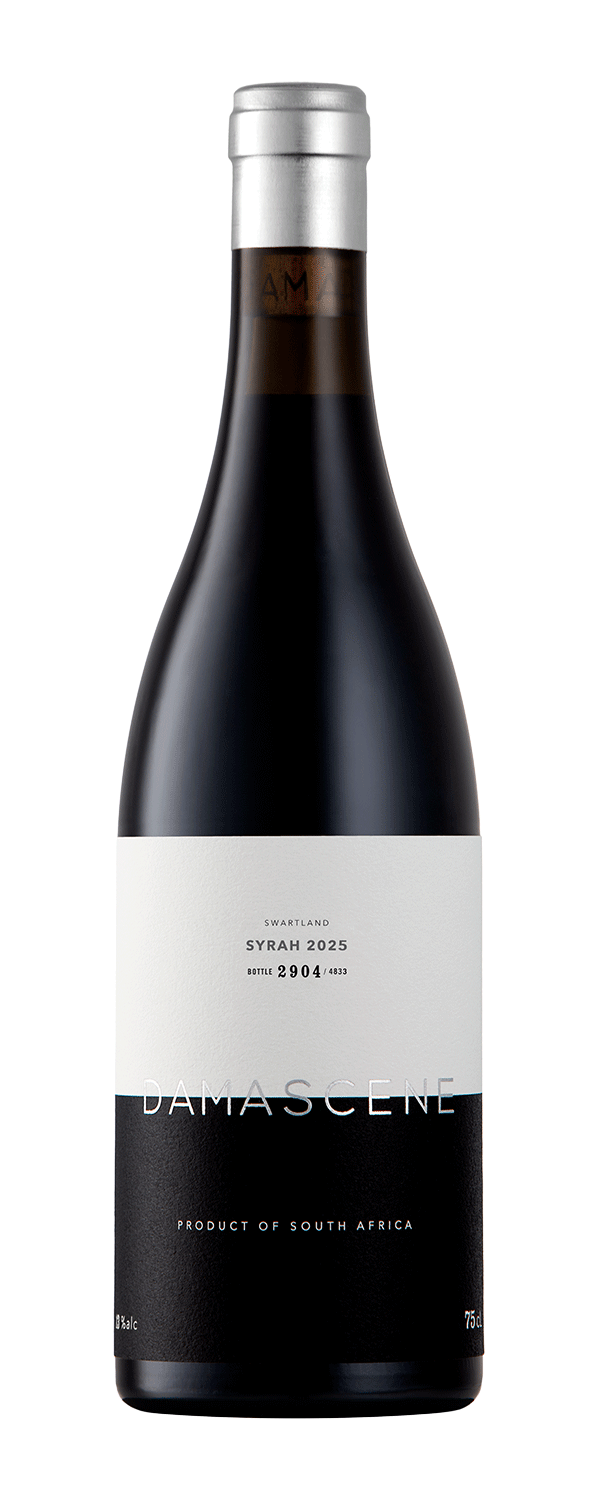
Wine of Origin Swartland
| Winemaker: | Jean Smit |
| Cultivar: | 100% Syrah |
| Origin: | Swartland |
Tasting notes:
The most finely woven of the trio, the 2025 Swartland Syrah is a lattice of dynamic fruit, spice and flowers.
The nose arrives clean and lifted: fresh blackberry and black cherry first, then clove, a drift of violets, and blood orange pith at the edges. The palate keeps that lattice intact. Raspberry and red cherry sit over citrus, with a candied top note like the shell of a toffee apple. Clove, aniseed and a turn of white pepper run through the fruit. Tannins are finely drawn, framing the fruit rather than gripping it.
By day three, the wine unfolds considerably: the fruit components deepen, clove grows more abundant, and cranberry and sour red cherry arrive behind the blood orange. The tannins hold their line the whole way — fine, persistent and unforced.
Notes on the 2025 Vintage:
The 2025 season was made in winter. Where the previous growing season had given the Swartland only 35 mm of rain between October and March, this one opened with winter rainfall above the long-term average (July was especially heavy). Budburst came seven to ten days later than usual, and the plentiful cold units told in its evenness: it came complete, and it came all at once.
Véraison followed slightly later than the previous season, even across the blocks and with excellent colour development. Christmas Day brought a sudden lift to over 30 °C, and then the season relented — cool nights, and vineyards that stayed exceptionally healthy right through to harvest. Our fruit was hand-harvested between 17 February and 4 March 2025, seven to ten days later than usual and nearly a week later than in 2024.
Vineyards:
The fruit for this wine comes from three markedly different Swartland sites. The first bush vine block is situated on the foothills of the Paardeberg, on Jakkalsfontein farm, and is rooted in free-draining decomposed granite soils. It makes up a little less than 10% of the blend, but brings perfume, spice, and purity.
The second vineyard is trellised according to the échalas system, and sits on the western foot of the Kasteelberg at 340m above sea level. This east-facing slope of exposed schist provides structure and fruit depth.
The final vineyard lies in the heart of the Swartland, facing east. These trellised vines are planted on Malmesbury shale and schist, lending the wine its mineral edge and structure. The Damascene team planted a further 2ha on this site in 2023.
Winemaking:
This Syrah shows the kind of concentration typical of low-yielding vineyards in Mediterranean climates. These sites all provide formidable structure, so a high degree of whole-berry fermentation and the submerged cap technique ensures that tannins stay soft without losing intensity.
Approximately 75% of the fruit was fermented as whole clusters, across a mix of tulip-shaped concrete fermenters and 1000L conical oak vats. The fruit from granitic parcels received gentle pump-overs — never more than twice daily — to preserve perfumed aromatics and purity of fruit. In contrast, fruit from shale and schist-derived soils was fermented under submerged cap. This far more gentle technique keeps tannins soft and brings breadth to the palate. Both primary fermentation and malolactic conversion occurred spontaneously. The wine was matured in 2000L Austrian oak vats for ten months and bottled without fining to ensure a more complex and authentic expression of Syrah.
Maturation:
This wine will continue to evolve and mature for more than a decade.
Technical:
Total production: 4833 x 750ml and 100 x 1500ml
Bottling date: 15 January 2026
Alc: 13.11 % Vol
pH: 3.65
TA: 5.1 g/L
RS: 1.9 g/L